
What does a successful chemical company look like in 2035? The Net Zero and Supply Chain Committees join forces for a session at EPCA's Annual Meeting in Vienna.

There is a clear business case for the net-zero transition but capturing it is not straightforward. And one insight surfaced repeatedly in conversations with industry professionals: the biggest barriers to progress are often no longer technical, but rather organizational. This quarter, the Net-Zero Transition Committee’s spotlight is EPCA's 60th Annual Meeting in Vienna, taking place from 5-8 October. The committee is joining forces with the Supply Chain Program Committee for a joint session, "Shaping Europe's Competitive Future: What Does a Successful Chemical Company Look Like in 2035?"
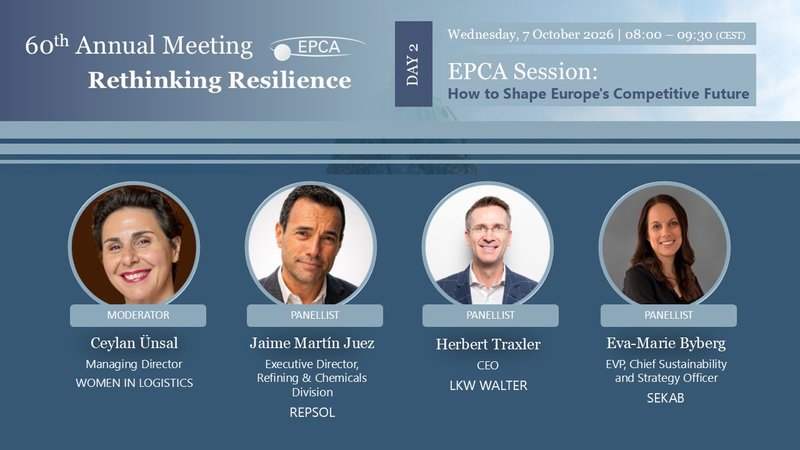
Wednesday 7 October 2026 | EPCA Session: How to Shape Europe's Competitive Future
As Europe's petrochemical industry faces mounting pressure on competitiveness, sustainability is increasingly being viewed through a different lens. Join us at the 60th EPCA Annual Meeting on Wednesday 7 October for the joint SCPC and Net-Zero Transition Committee session, 'How to Shape Europe's Competitive Future’.
Europe's industrial landscape is under profound stress - from energy costs and geopolitical disruption to weakening demand and intensifying global competition. The instinct in crisis is to defend existing structures. But in order to survive, the European Petrochemical industry needs to start boldly building tomorrow.
What does a genuinely competitive European chemical company actually look like in 2035 - and what does it take to build one? How can we reframe this crisis to view it as an opportunity for transformation? The answer cuts across the whole organisation. It is a supply chain that is resilient enough to absorb disruption and agile enough to turn it into advantage. It is a sustainability transition that has been converted from a compliance burden into a source of investment, differentiation and growth. And it is an organisation that attracts, develops and retains the people capable of delivering both. The companies that will lead in a decade are the ones treating resilience, sustainability and talent not as separate agendas managed by separate teams - but as a single, integrated bet on where competitive advantage comes from.
If you missed them, please have a look at the committee’s first publications below.
EPCA Launches Factsheets & Enablers to Guide Members on the Path to Net-Zero
Developed with Guidehouse, this resource gives business developers, engineers, and executives - especially in SMEs - ten factsheets and two enablers covering the technologies most relevant to decarbonizing chemical operations: heat optimization, downstream energy efficiency, e-boilers and heat pumps, power purchase agreements, hydrogen, biogas/biomethane, chemical recycling, bio-based chemicals, CO2 as feedstock, and carbon capture services. Each factsheet lays out trend analysis, cost-benefit considerations, regulatory implications, and environmental impact, so members can prioritize where to act first.
Turning Sustainability into Business Impact
Also produced with Guidehouse, this guide reframes sustainability as a strategic lever rather than a compliance exercise. It walks through 11 major sustainability frameworks and initiatives - from the GHG Protocol and the Science Based Targets initiative to certification schemes like ISCC PLUS and REDcert2 - and shows how they can support differentiation, brand credibility, and long-term valuation. It is a useful starting point rather than a technical deep dive, making it well suited to share with colleagues who are newer to the sustainability conversation.
The Net-Zero Transition Committee currently counts 9 members, primarily representing petrochemical producers. The Committee is coordinated by Lydia Pernal-Stoddart.
✋ Interested to know more? Drop us an email: netzero.committee@epca.eu


